Airbnb Highlights
The Problem
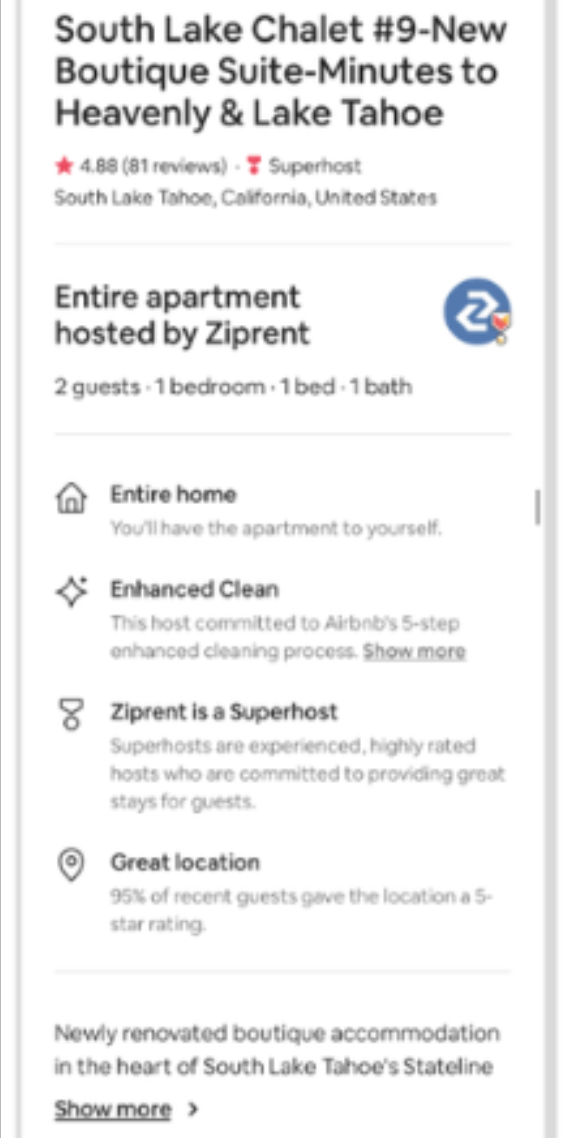
Airbnb listing pages contain a lot of information, ranging from property details and amenities to location context, which made it hard for users to understand a listing’s overall value or determine if its a good fit.
To address this, we introduced Highlights, a feature designed to surface the most meaningful and differentiating qualities of a listing in a scannable, easy-to-compare format.
Highlights are meant to help users quickly form an impression without needing to parse the full page of details.
Without a clear framework or set of criteria, listings often surfaced too many Highlights—sometimes up to 7 per property.
With no prioritization, less relevant or redundant information took up valuable space on the listing page, making it harder for users to quickly understand what actually mattered about the stay.
To the left, you’ll see that we were prioritizing mundae information like “entire home” at the top of the page.
Understanding user needs
Through multiple research sessions, we found that guests consistently prioritize 4 key factors when evaluating an Airbnb listing:
location, price, amenities, and flexibility.
We used these as the foundation for our Highlight framework, ensuring the most decision-critical attributes were surfaced in a clear, scannable way.
While location and price have always been core drivers of booking decisions, we saw a growing emphasis on amenities—especially as guests increasingly searched for longer stays and remote friendly spaces in the post-pandemic period.
Creating principles
Based on this, we defined a simple criteria for Highlights built around 2 core requirements:
Desirable features these help guests evaluate a listing in a familiar, practical way, using attributes like location and amenities that support traditional travel decision-making.
Unique characteristics these on the other hand, surface what makes an Airbnb stay feel distinctive and memorable, such as standout hospitality or other one-of-a-kind qualities.
Together, this balance ensured Highlights were both useful for comparison and expressive of what makes each listing special.
A closer look at location highlights
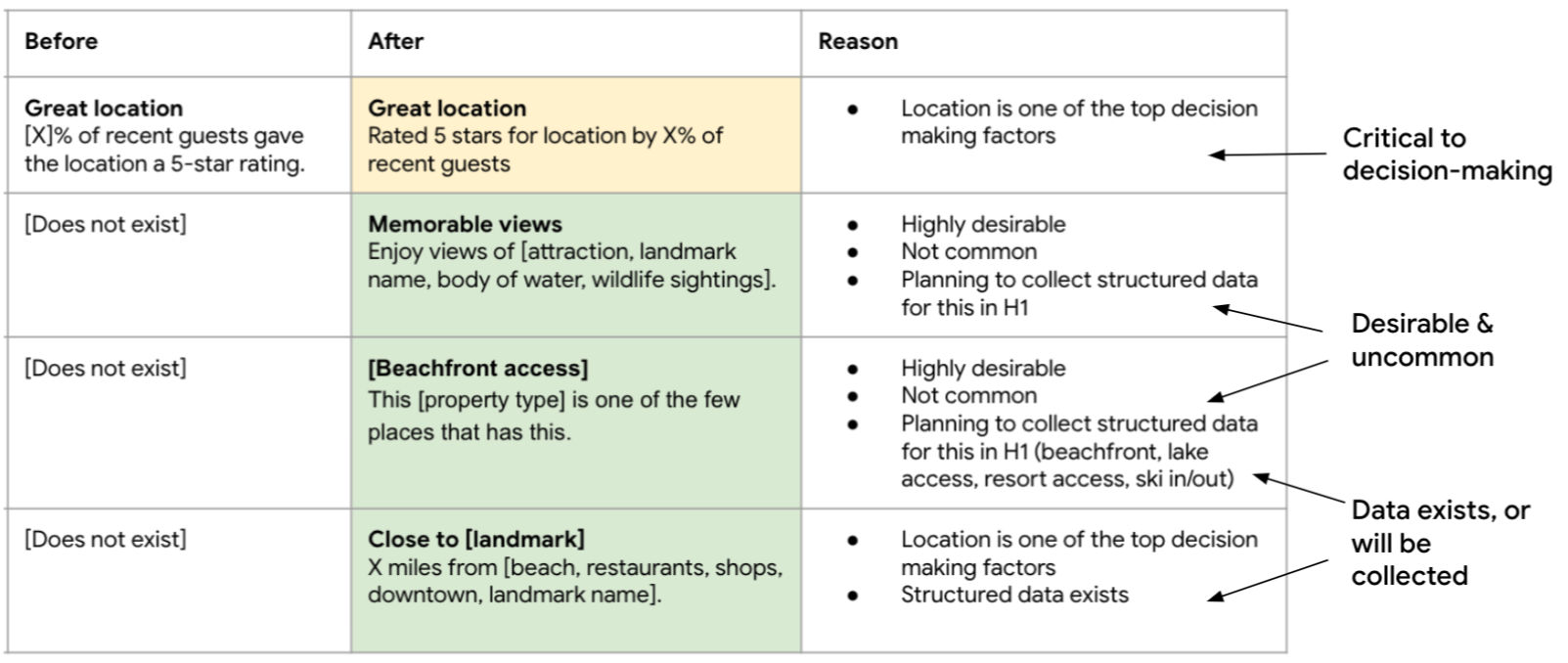
We started by revisiting how location was represented in Highlights. Previously, there was only a one location-based highlight, despite location being one of the most important factors in booking decisions.
Working with the team, we mapped out the location signals already available in our data system, such as ocean views, beachfront access, and proximity to popular landmarks. We used these to create more meaningful, descriptive highlights.
We then evaluated each one through a simple lens: whether it was both desirable to guests and distinctive enough to stand out.
Next we looked at amenity highlights
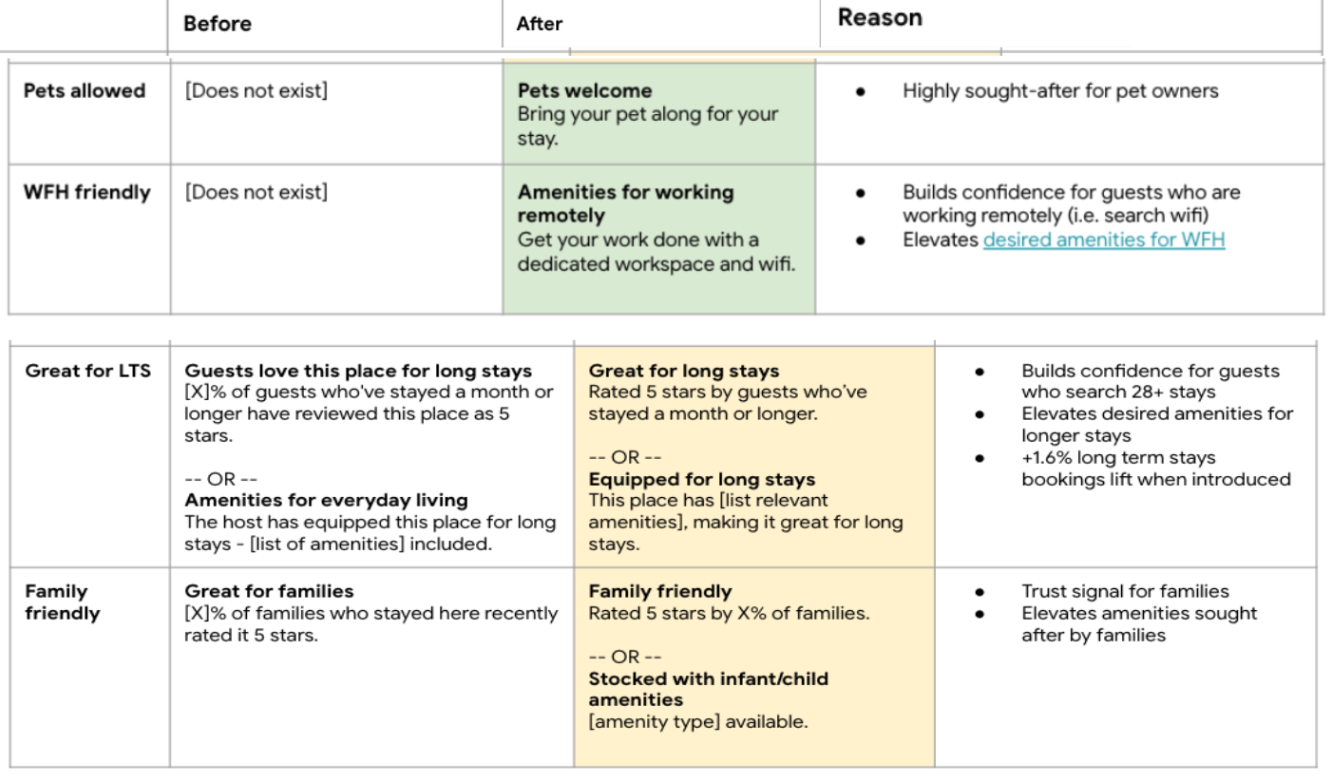
Recognizing that certain amenities strongly influence booking decisions, we took a closer look at the amenity highlights to consider which ones mattered most across different traveler personas to ensure relevance.
We also introduced new highlights to reflect shifting travel needs in a post-pandemic context , such as pet and WFH friendly details (shown in green), while refreshing existing ones to improve clarity and tone (shown in yellow).
Final copy for location & amenity highlights
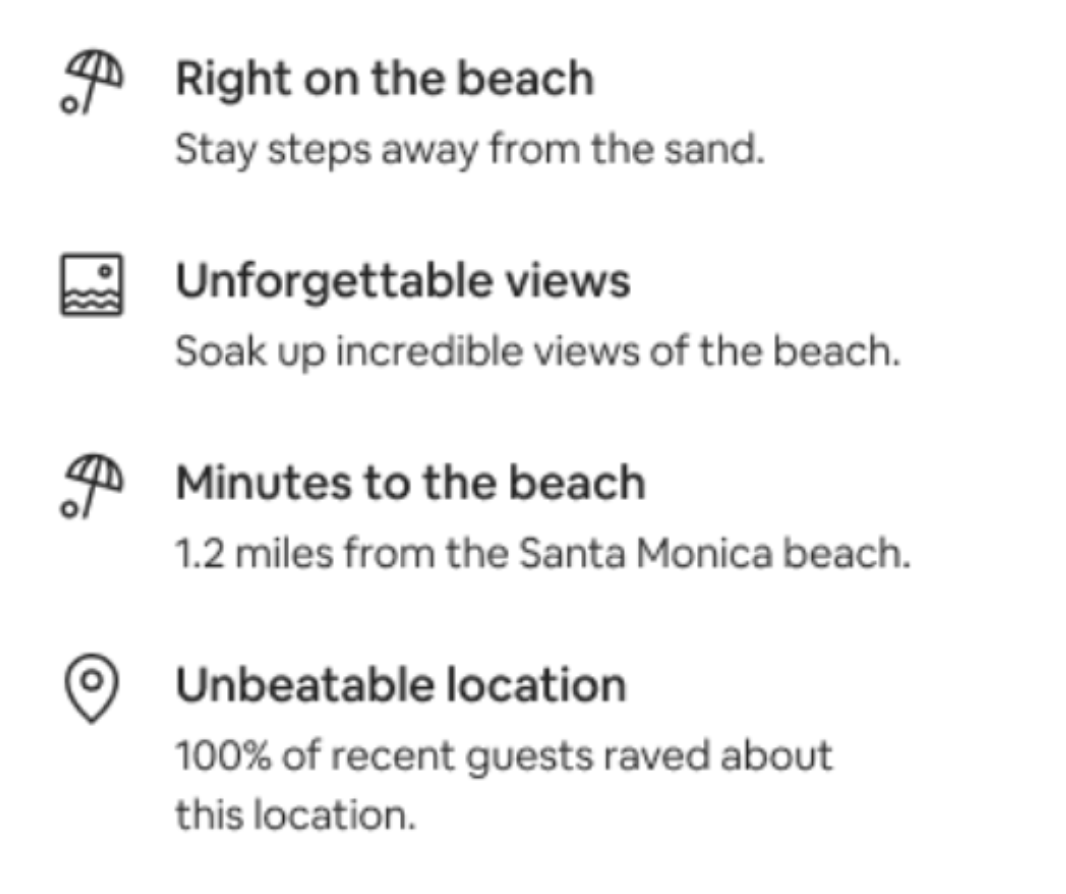
Location highlights
Before
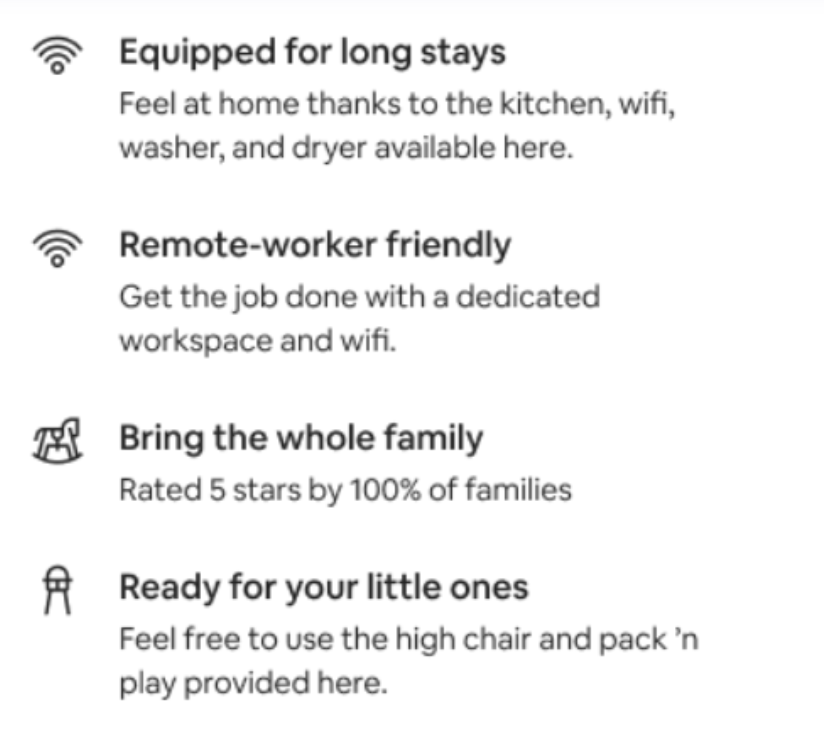
Amenity highlights
Voice & tone refresh
After
Great for families
Kid-friendly amenities
Hot tub available
Fireplace available
Bring the whole family
Ready for your little ones
Unwind in the hot tub
Cozy up to the fireplace
As travel restrictions began to ease in a post-pandemic world, we explored how the copy could help re-energize excitement around travel. We leaned into more evocative, enthusiastic language to help users reconnect with the idea of staying at a listing.
The goal was to make Highlights feel more immersive—helping travelers easily picture themselves in the space.
What I delivered
This is taken from the content doc that was delivered to the engineering team.
Criteria
A strong Highlight meets both conditions:
Desirable to travelers
Uncommon or differentiating within the market
This ensures Highlights remain meaningful signals, not generic feature lists.
Principles
1. Lead with tangible value
Highlights should immediately communicate why a feature matters—not just what exists.
Example
Instead of: Crib available
Say: Ready for your little ones with a pack ’n play and crib provided
2. Help guests picture themselves there
Strong Highlights create instant mental imagery and emotional connection.
Example
Instead of: Beachfront
Say: Wake up right on the beach with sweeping ocean views
3. Prioritize clarity over cleverness
Since Highlights support fast comparison, they must be instantly scannable.
Tone & Writing Guidance
1. Speak to the experience, not just the feature
Frame amenities around how guests will use or feel about them.
Example
Instead of: Ocean view
Say: Wake up to sweeping ocean views
2. Use natural, conversational language
Highlights should feel human and effortless, not promotional.
Avoid:
Marketing clichés
Overly excited phrasing
Excessive punctuation
Instead of: “An unforgettable beachfront paradise!!!”
Say: Right on the beach for sunrise walks
3. Write with specificity
Specific details build trust and help guests compare listings more confidently.
Example
Instead of: Great location
Say: 10-minute walk to downtown
String Structure
Format:
[HEADER] Attribute / feature
[SUBCOPY] Experiential payoff
Examples:
Perfect for remote work
Fast Wi-Fi and a dedicated workspaceSteps from the beach
Enjoy ocean views all day
Where we landed
As a result, listing pages now surface the most unique and desirable aspects of a stay at the top of the experience, while secondary details like property type and cancellation policy are moved slightly lower in the hierarchy.
Impact
+1.1% increase in bookings with 60% global coverage
+1.5% lift in bookings for both Instant Book and Request to Book flows